
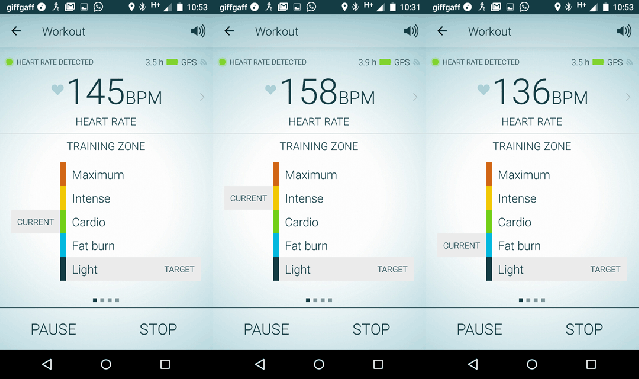
When you get a wearable and look at the App you can suffer from “Data Shock” as many graphs are thrown at you showing how good or bad you have been on a certain day. You can then reject this information as “too much” and climb back onto the sofa.
If you want to make one change next year to get yourself fitter its to think about exercising in your heart zones. This article can help you calculate your zones.
Your maximum heart rate is calculated by taking your age and subtracting it from 220.
So if you are 47 your maximum heart rate is 220 -47 = 173 BPM.
If you take this figure and multiply that by 0.65 you get the minimum of your Zone 1 heart rate = 173 x 0.60 =104.
Multiply by 0.70 and you get the maximum heart rate for your zone 1 = 173 x 0.70 =121 .
So you’ve got your Zone 1 , 104 to 121 BPM.
Zone 2 is 70 to 80% of your max heart rate . 121 – 138 BPM
Zone 3 is >80% of your max heart rate > 138 BPM
You are ready to start your program.
This program will have you burning more calories in 30 minutes than you would if you just went at a steady rate for the same amount of time.
Zone 1 range is the best place to start. You will need a decent heart rate monitor (why not try the Jabra Sports Pulse ? ) to keep track of your bpm. Keep your heart rate in zone 1, when your heart rate is to high, decrease the workload and vice versa. When you can keep your bpm in zone 1 for 30 minutes for 5 five days in a row you are ready to add zone 2 into the rotation. Then you use intervals of zone 1 & 2. and so on.
Zone 1 becomes your base range, the range you want your heart rate to drop back to.
It is dangerous for your heart rate and blood pressure to go really high and stay there as you will put yourself at risk for heart attack or stroke.
Exercising at lower percentages of your maximum heart rate burns a greater percentage of fat calories and allows for recovery, while exercising at a high rate burns more calories overall and increases the strength of your heart muscle.
 whichwearable.co.uk
One thought on “Using Heart Rate feedback during exercise”